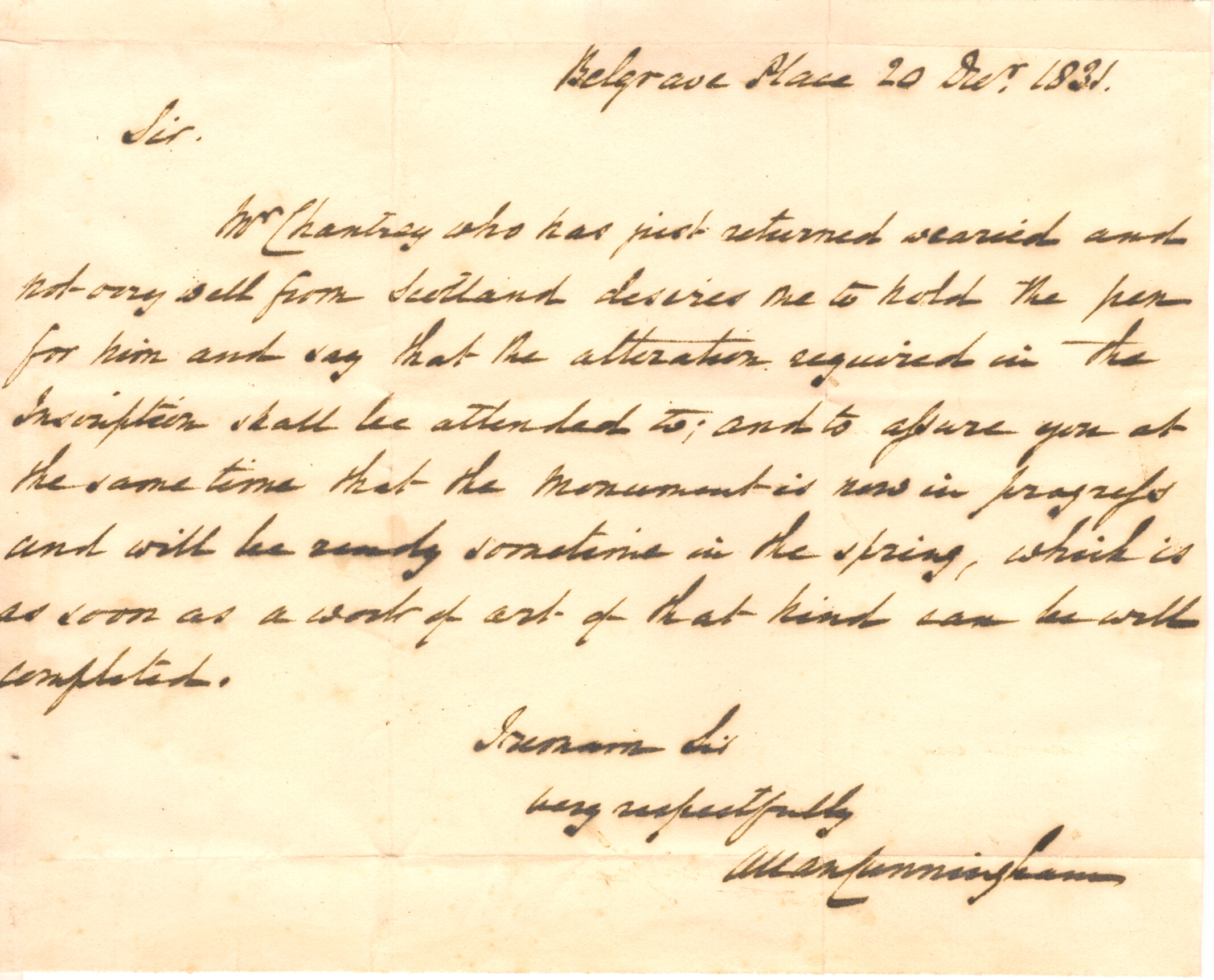
CUNNINGHAM
(Allan, 1784-1842, Scottish Writer & Poet)
Autograph Letter signed to an unnamed correspondent
saying that "Mr Chantry [Sir Francis Leggatt Chantrey RA, 1781-1841, sculptor] who has just returned wearied and not well from Scotland desires me to hold the pen for him and say that the alteration required in the Inscription shall be attended to, and to assure you at the same time that the monument is now in progress and will be ready sometime in the spring, which is as soon as a work of art of that kind can be well completed ...", 1 side oblong 8vo., Belgrave Place, 20th October
Item Date:
1831
Stock No:
39064
£150
Add to Wish List
Order/Enquire
Full Details
|
|
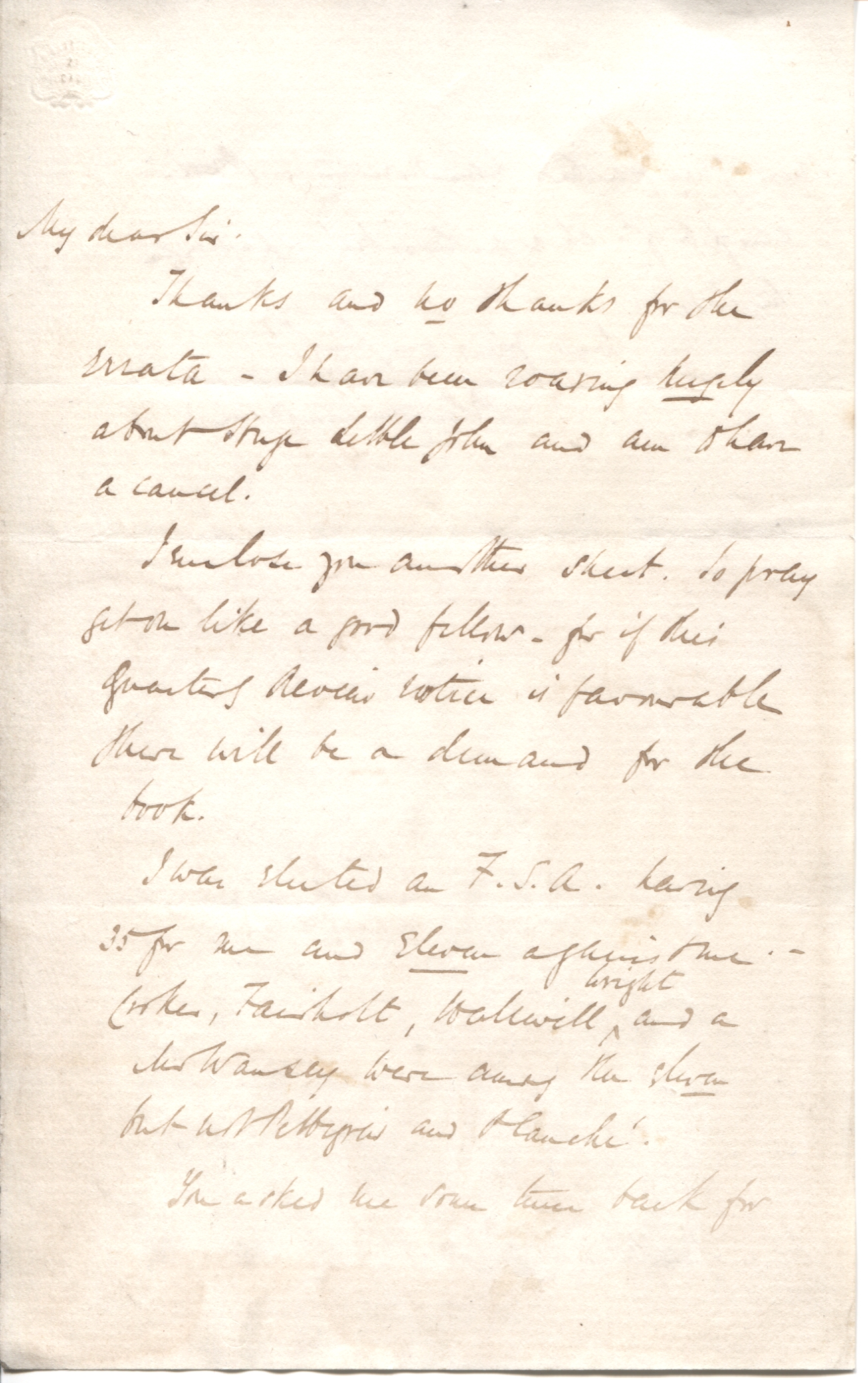
CUNNINGHAM
(Peter, 1816-1869, Author and Critic, son of Allen Cunningham)
Autograph Letter Signed to Henry CAMPKIN
(1815-1890, Author) thanking him for "the errata ... I enclose you another sheet. So pray get on like a good fellow - for if this Quarterly Review notice is favourable there will be a demand for the book. I was elected an F.S.A. having 35 for me and eleven against me - Croker, Fairholt, Haliwell, Bright ... were among the eleven but not Pettigrew and Planché. You asked me some time back for some of my father's handwriting. Pray accept ye characteristic specimen enclosed ...", 2 sidees 8vo., 27the March no year
Item Date:
0
Stock No:
41593
£65
Add to Wish List
Order/Enquire
Full Details
|
|
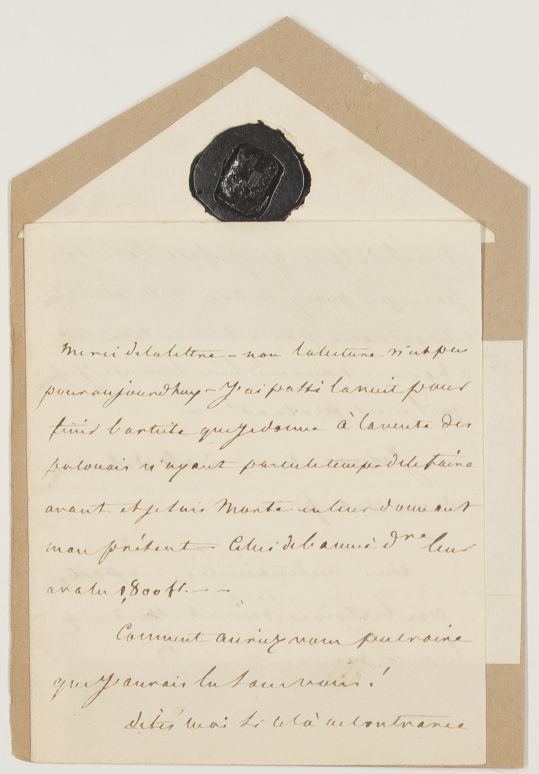
D'ABRANTÈS
(Laure Constance, 1784-1838, French writer, wife of Marshal Junot, Duchesse)
AN unsigned, in French with translation,
to 'Monsieur Sainte Barbe', the political writer and poet Joseph Auburtin, saying "the reading is not for today. I spent the night finishing the article which I am giving to the sale for the Poles, ... and I am Dead ... Last year's was worth 1,800 fr. to them", she could not "have given a reading without you!", she asks him whether "Adolphe" has been "put out" by her making the article, "I will get down to work straight away ... and my charming old beau ['céladon'] makes me very happy. I hope he realises that", she will "ask M. d'Amberieux", probably the novelist son of Pierre d'Ambérieux, (1732-1821), "to come too ... bring your stories and you and they will be welcome", 2 sides 16mo with envelope front and seal on separate flap bearing crowned 'C.A.', no place, no date, c.
Item Date:
1835
Stock No:
18842
£95
Add to Wish List
Order/Enquire
Full Details
|
|
[DANTE ALIGHIERI
(1265-1321, Italian Poet)]
Stitched notebook signed 'H.C. Gibson', titled "Sources of information concerning Dante Alighieri"
compiled for 'Mr B' to use with a pupil, 16 sides 8vo., no date, c.
Item Date:
1840
Stock No:
12493
£30
Add to Wish List
Order/Enquire
Full Details
|
|
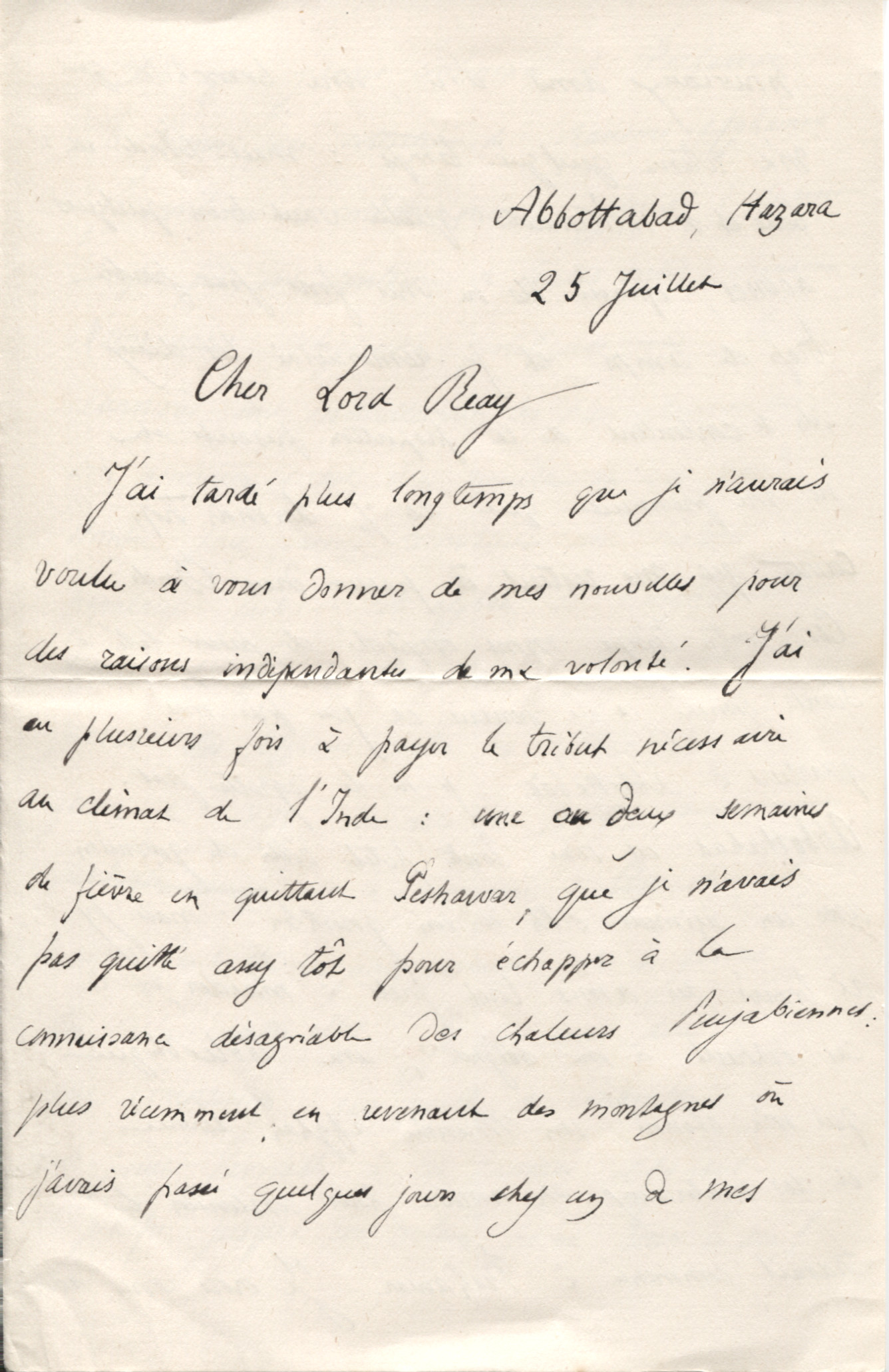
DARMESTETER
(James, 1849-1894, French Author, Orientalist and Antiquarian)
Important Long Autograph Letter Signed to Lord REAY
(Donald James Mackay, 1st Baron Reay, 11th Lord, 1839-1921, Dutch born British Administrator and Liberal Politician) saying that he has “delayed writing to you longer than I would have liked for reasons beyond my control. I have had to pay the necessary price for the Indian climate several times; a week or two of fever upon leaving Peshawar, which I hadn’t left early enough to escape the unpleasant experience of the Punjabi heat; more recently, upon returning from the mountains where I had spent a few days with one of my new friends here, bronchitis kept me here for a while. But India is so beautiful and so interesting that it is well worth a few setbacks, provided they don’t cause too much delay, and I will thank the gods if they are content with the current proportion and only take 20% of the all-too-short months I have left to spend in India. These setbacks prevented me from spending the summer in Simla as I had planned, and I settled in Abbottabad instead; I don’t regret it. Abbottabad is a very small garrison town, with a Sikh regiment and a Gurkha; but I found friends there all ready to help me and, if necessary, to care for me, a library that astonished me, a devoted Afghan Munshi, and plenty of material to continue the work I began in Peshawar. I believe I told you that I started compiling a collection of Afghan songs in Peshawar. I continued and am still continuing; I have about a hundred of all kinds—love songs, religious songs, political songs, and so on. The latter are naturally the most interesting. My ambition would be to collect enough of them to be able to reconstruct a popular history, told from the Afghan perspective, of Afghanistan since the end of the last century. I have accounts of the Afghan wars against the Sikhs, of the 1835 war, of the 1879 war, of the Ambela campaign, and, perhaps the most curious, of the wars between the tribes. I must tell you that the overall impression is not favourable to these poor Afghans and, to a certain extent, justifies all the bad things said about them in English newspapers and books. There is a lack of moral sense and loyalty displayed with a naiveté and recklessness that is not without a certain charm. The literary value of these songs varies greatly; a few are charming, but they are few and far between; the majority are commonplace and clichés. Clichés exist in popular literature as well as in scholarly literature. The authors of these songs are organised into schools; a famous dum has students who begin by learning his songs to sing them in public and who later compose for themselves. I believe that to truly understand what the Gallic bards were like, one would need to spend a few months in the inner circle of the dums. You can see that I am not particularly enthusiastic about my subject, which is, however, the primary duty of a scholar. The collection will be of great interest to philologists, as it will offer a specimen of the actual Afghan language and true literature. Everything written in Afghan consists only of translations from Persian and Arabic and gives no more insight into the genius and language of the people than our translations from Latin and Greek would. I believe, however, that the general public, and especially the English-speaking public, will find some interest in it and perhaps even, through the novelty of it, will discover beauties that have escaped me. I intend to stay here until the end of September. I am obliged, to my great regret, to confine myself exclusively to Pashtu, because once I leave, I will find no further opportunity to continue my collections. Yet, in this little corner of the world, there are so many curious specimens that I will not find elsewhere; not only Sikhs, but also those brave Gurkhas, Mongols who have learned Sanskrit and speak it in their own way, the Dogras, and so many others. But ever since I set foot in India, every step brings the same regret; so many beautiful things to leave behind, so many magnificent opportunities to miss. The story of my journey will be, above all, the story of my sacrifices. From here, I intend to visit the Ganges Valley, making a special stop in Rohilkhan, which was colonised two centuries ago by an Afghan settlement. Sir Alfred Lyall, whose advice I sought on this matter, presenting myself to him under the kind patronage of Lady Reay, advises me to stop in the state of Rampor. It is the only Rohilkhan state that has remained independent, and he is to arrange an introduction for the Nawab there. I will hardly be back in Bombay before the end of November and will have at most three months to give to the Parsis, especially since I would like to take the opportunity to make a trip to Madras and Hayderabad. Truly, it is madness to come to India when one only has a year to give it. One would need at least three years to get even a basic idea of the country. I sometimes hear news of you from the newspapers here, although they seem to think that Punjab is all of India. I read with great pleasure your witty and insightful speech on the education of the Hindus last week...”, 8 sides 8vo., Abbotabad, Hazara, 25th July no year but circa
Item Date:
1886
Stock No:
43599
£975
Add to Wish List
Order/Enquire
Full Details
|
|