Science
TYNDALL
(John, 1820-1893, Scientist)
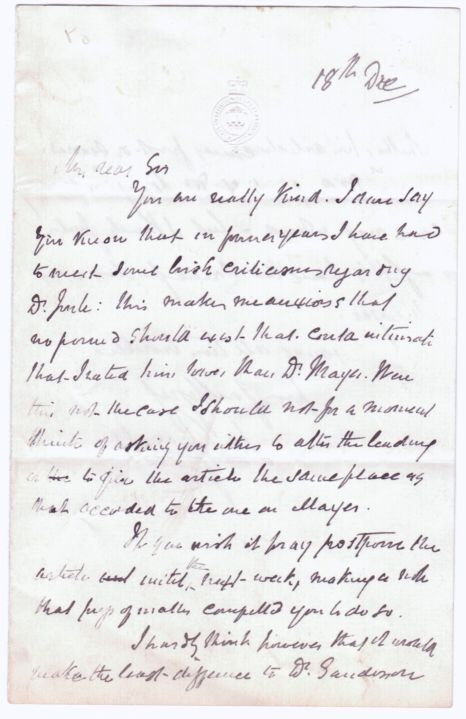
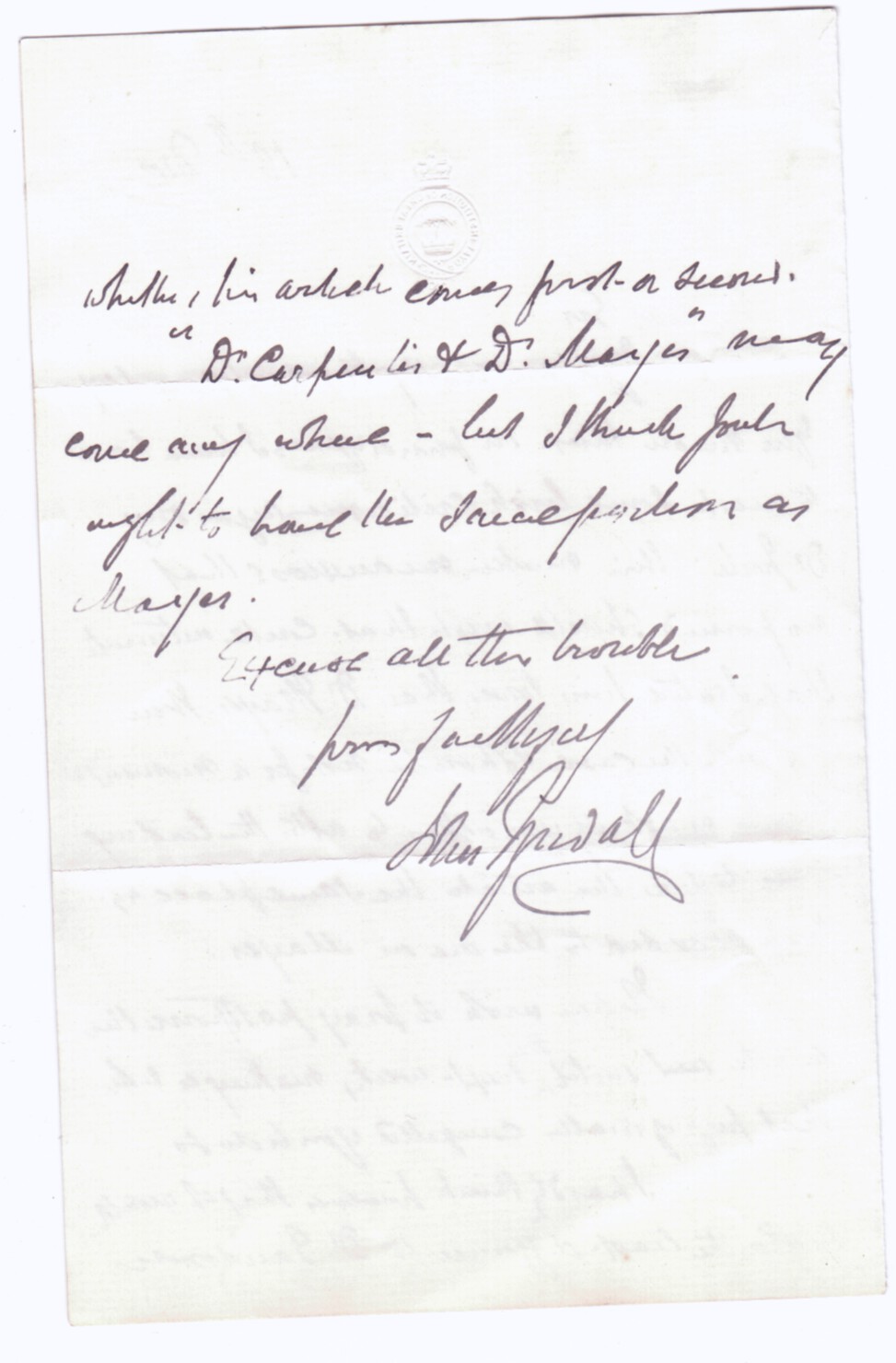
Autograph Letter Signed to an unnamed correspondent, (probably Normal Lockyer),
thanking him for his kindness and saying that in former years I have had to meet some brisk criticisms regarding Dr Joule:, (James Prescott Joule, 1818-1889, the physicist), this makes me anxious that no ground should exist that could intimate that I rated him lower than Dr Mayer (Julius Robert von Mayer, 1814-1878, the German physician and physicist). Were this not the case I should not for a moment think of asking you either to alter the leading, the space between lines, or to give the article the same place as that accorded to the one on Mayer. If you wish it pray postpone the article until the next week, making a note that press of matter compelled you to do so. I hardly think however that it would make the least difference to Dr Sanderson whether his article comes first or second. 'Dr Carpenter & Dr Mayer' may come any where - but I think Joule ought to have the same position as Mayer, with apologies for the trouble, 2 sides 8vo., Royal Institution headed paper, 18th December no year, but
Item Date: 1871
£475
✓ Available
Background
In papers of 1841 (unpublished) and 1842, Mayer propounded the equivalence of work and heat and the conservation of energy when work and heat are exchanged, and went on to determine a numerical value for the mechanical equivalent of heat. In 1848 he discovered the credit had been given to Joule which, coupled with the deaths of two of his children, led to his attempted suicide. In 1862, Tyndall revived Mayer's work in a lecture at the Royal Institution, and in papers in the Philosophical Magazine, 1863-1864, whose avowed object was to raise a noble and a suffering man to the position which his labours entitled him to occupy. Mayer showed genius in applying the principles to a remarkable range of phenomena, terrestrial and cosmic. For the controversy, in which Tyndall succeeded in making equal claims for both, see Eve & Creasey's life of Tyndall, pp. 94-105. Joule was awarded the Copley Medal (The Royal Society's highest award) in 1870 and Mayer in 1871.
John Scott Burdon Sanderson, (1828-1905, from 1899 1st Baronet, the pathologist and physiologist) was at this time professor at University College London (later at Oxford). In 1873 he began to examine the role of electricity in physiology, after Darwin inquired about the Venus flytrap. The nervous system was also a main interest of William Benjamin Carpenter, (1813-1885, the biologist, at this time Registrar of University College London), together with its relation to the moral will.
The recipient is probably Sir Joseph Norman LOCKYER (1836-1920) who was an English Scientist and Astronomer. He was the founder and first Editor of the influential journal Nature. Tyndall is referring to the following articles in Nature from December 1871.
14 Dec 1871, pp. 117–20, article by JT on 'Copley Medalist of 1871' (this was Mayer): https://www.biodiversitylibrary.org/item/90025#page/135/mode/1up
21 Dec 1871, pp. 137–8, article by JT on 'Copley Medalist of 1870' (this was Joule):https://www.biodiversitylibrary.org/item/90025#page/155/mode/1up
21 Dec 1871, pp. 143–4, article by JT on 'Dr. Carpenter and Dr. Mayer': https://www.biodiversitylibrary.org/item/90025#page/160/mode/1up
28 Dec 1871, pp. 161, letter to editor by William B. Carpenter on 'Dr. Carpenter and Dr. Mayer':
https://www.biodiversitylibrary.org/item/90025#page/179/mode/1up
Stock No. 36259
Guaranteed Authentic
Worldwide Shipping
ABA / ILAB Member
Returns Policy