Literary
THE ORIENTALIST SENDS A REPORT ABOUT INDIA TO THE GOVERNOR OF BOMBAY
DARMESTETER
(James, 1849-1894, French Author, Orientalist and Antiquarian)
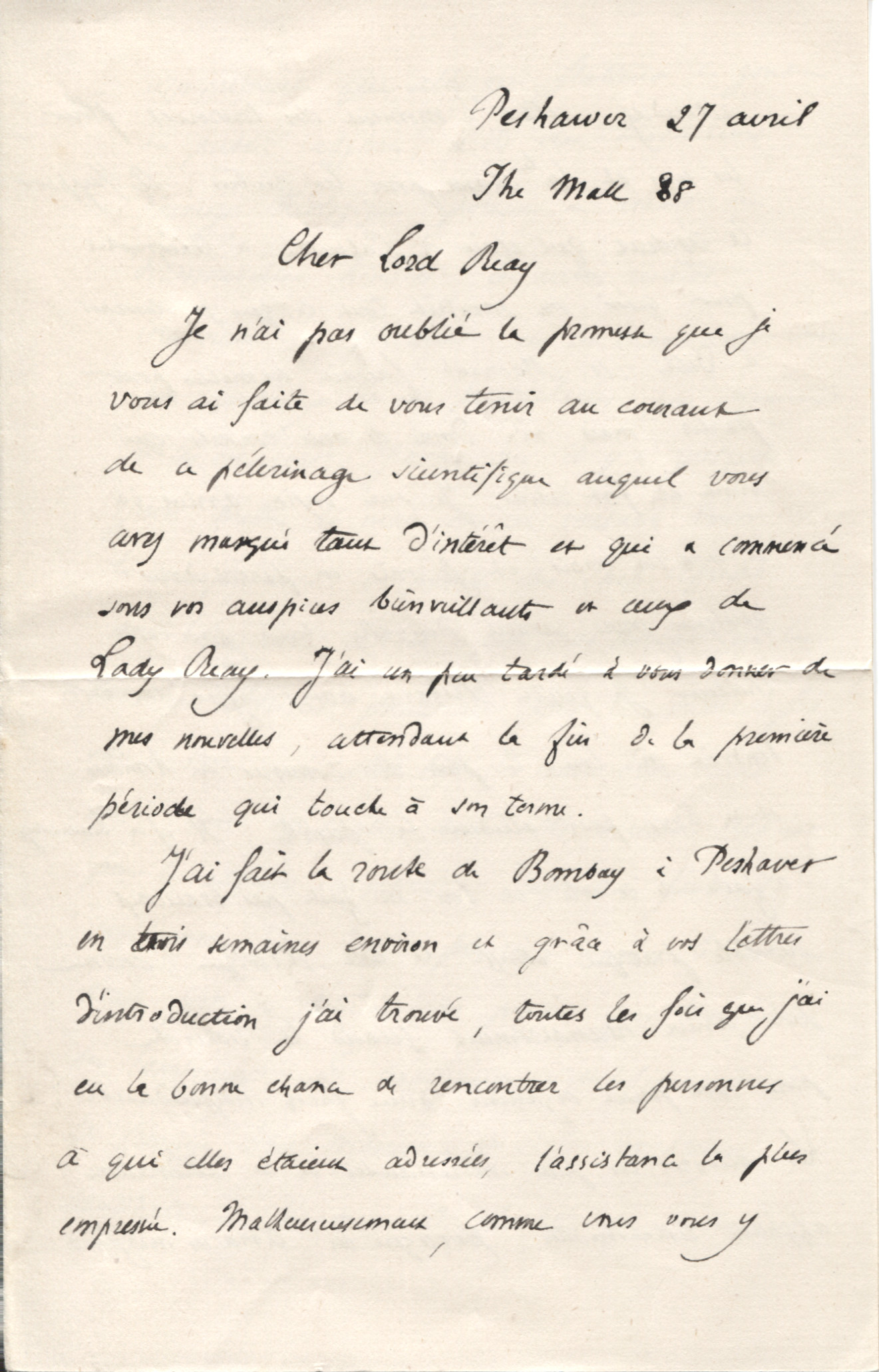
Important Long Autograph Letter Signed to Lord REAY
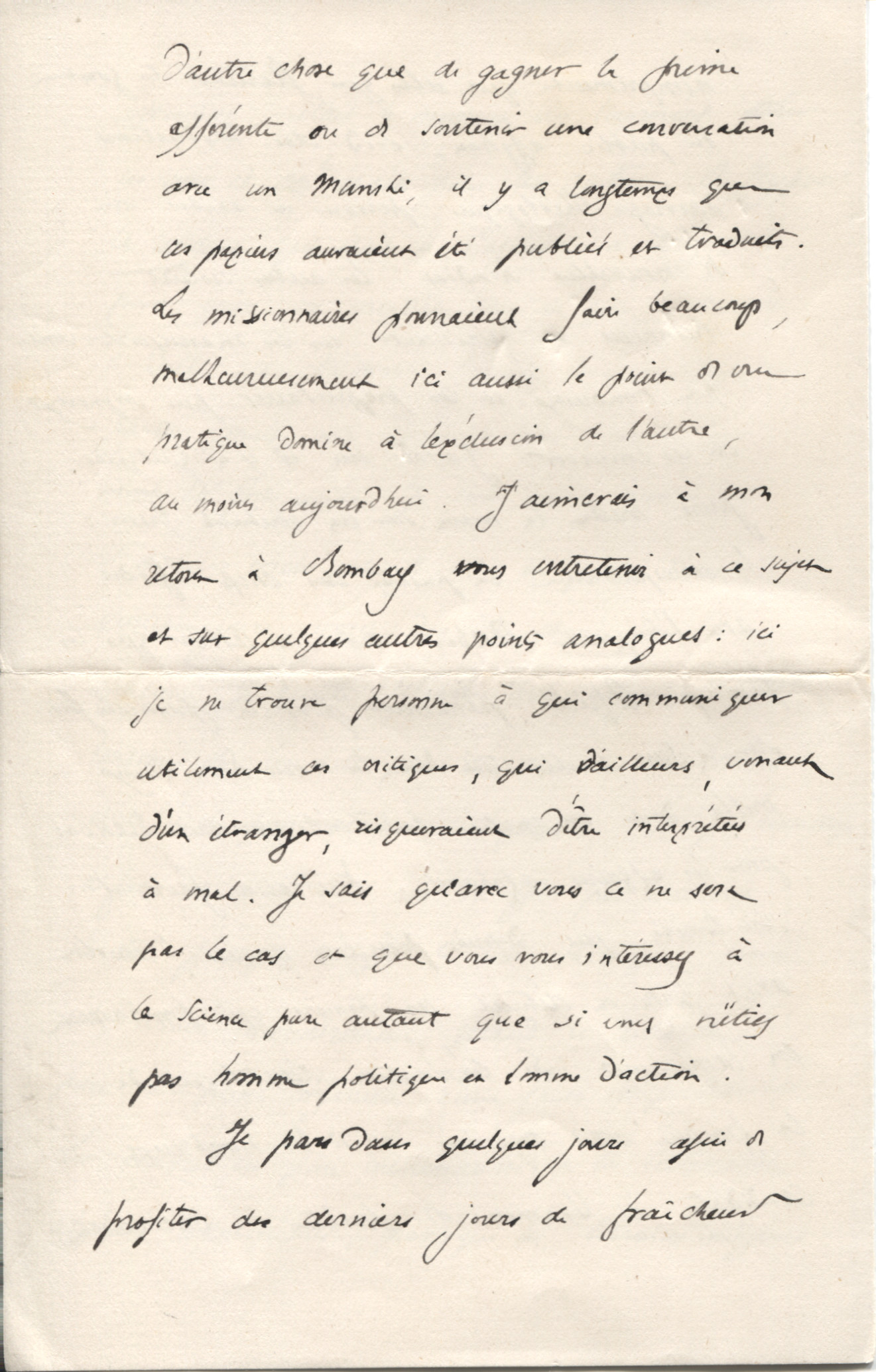
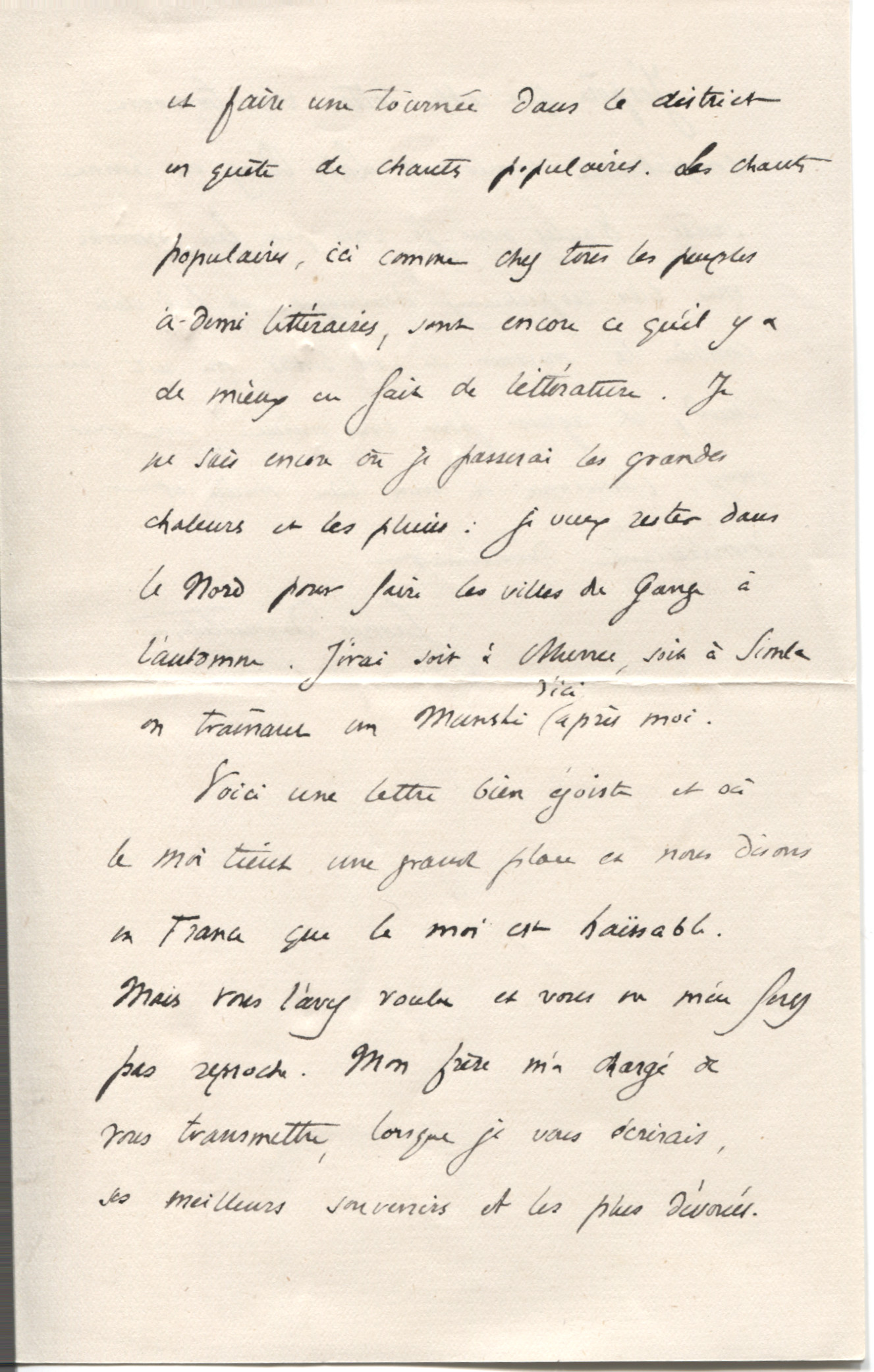
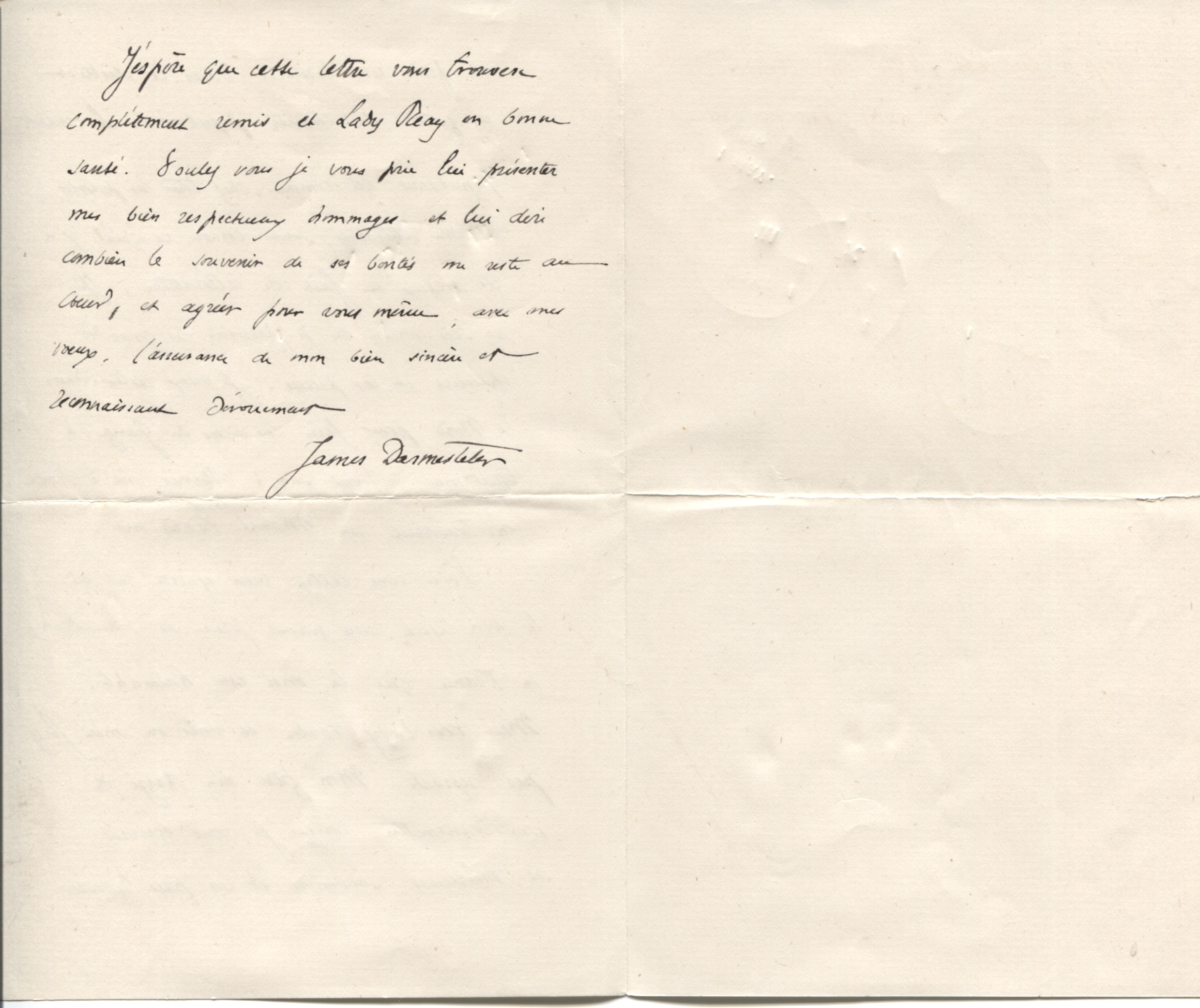
(Donald James Mackay, 1st Baron Reay, 11th Lord, 1839-1921, Dutch born British Administrator and Liberal Politician) saying that he has by no means forgotten my promise to keep you informed of this scientific pilgrimage, in which you have taken such kind interest and which began under the gracious auspices of Yourself and Lady Reay. I have been somewhat slow in writing, choosing to wait until the close of this first phase of my journey — a moment which is now approaching. My travels brought me from Bombay to Peshawar in the span of about three weeks, and thanks to your letters of introduction, I received the most generous welcome whenever I was fortunate enough to encounter their intended recipients. Unfortunately — though perhaps as you anticipated — it was the season of tours for some and hunting trips for others. In Jaipur, the Resident was in Calcutta, yet he telegraphed to ensure that every facility was offered to me. In Delhi, Mr. MacNabb was preparing to depart, but nonetheless provided valuable guidance that has since served me well. I arrived in Peshawar a month ago and shall leave in a few days, driven away by the advancing heat. I go with genuine regret, for there is no place richer in resources — both in people and in books — for the study of Pashtu. There is much to be accomplished here, and yet so little is being done: the practical demands of administration consistently stifle theoretical pursuits, as inevitably occurs when pure research lacks independent support. The most intriguing works of Afghan literature remain unpublished, for local printers cater only to popular tastes — Persian or Arabic theological treatises, or Hindi tales. Everything else lies neglected and too often disappears entirely, for manuscripts are rare, and their custodians regrettably careless. Only a few days ago I believed I had stumbled upon a scholarly treasure: the Pashtu correspondence between the Afridi chiefs and Emperor Akbar — the very period in which that renowned tribe first emerges in history. The papers were said to be in the possession of an elderly mullah, whose ancestor served as Akbar's secretary for Afghan affairs. But upon inquiry, I learned that the documents had been lost — or destroyed — some years ago, as they were falling to pieces. Had the scientific exploration of this frontier been better organised, had candidates for the Pashtu examinations been motivated by anything beyond prize money or the ability to converse with a munshi, such documents would long since have been edited, translated, and preserved. Missionaries might also contribute greatly; yet here again, practical concerns prevail to the exclusion of all else, at least for now. On my return to Bombay, I would welcome the opportunity to discuss this and other matters of a similar nature with you. Here, I can find no one to whom such criticisms may be usefully addressed — and coming from a foreigner, they might easily be misinterpreted. I am certain this would not be the case with you, whose interest in pure knowledge is as great as if you were neither a statesman nor a man of action. In a few days, I shall take advantage of the last trace of cool weather and travel through the district in search of folk songs. Here — as everywhere among peoples whose literary tradition remains in formation — these songs constitute the most vivid and authentic expression of their culture. I do not yet know where I shall spend the worst of the heat and the rains, though I intend to remain in the North so that I may visit the cities of the Ganges in the autumn. I shall go either to Murree or to Simla, accompanied by a local munshi. This is, I fear, a somewhat selfish letter, in which the first person intrudes too freely; and in France, they say that self is a most detestable thing. But you asked for my impressions, and I trust you will not hold the indulgence against me. My brother has charged me, whenever I write to you, to offer the assurance of his warm and devoted regards. I hope this letter finds you fully recovered, and that Lady Reay is in the best of health..., 6 sides 8vo., Peshawar, 27th April no year but
Item Date: 1886
£875
✓ Available
Background
In 1885 Darmesteter was appointed professor in the Collège de France, and was sent to India in 1886 on a mission to collect the popular songs of the Afghans, a translation of which, with a valuable essay on the Afghan language and literature, he published on his return. His impressions of British rule in India were conveyed in Lettres sur l'Inde (1888).
In 1885 Lord Reay was appointed Governor of Bombay, a post he held until 1890. He was appointed a Knight Grand Commander of the Most Eminent Order of the Indian Empire in 1887 and a Knight Grand Commander of the Most Exalted Order of the Star of India in 1890. After his return to Britain he served as Under-Secretary of State for India between 1894 and 1895 in Lord Rosebery Liberal administration.
Transcription
Peshawar 27 avril The Mall 88
Cher Lord Reay, Je n'ai pas oublié la promesse que je vous ai faite de vous tenir au courant de ce pèlerinage scientifique auquel vous avez marqué tant d'intérêt et qui a commencé sous vos auspices bienveillants et ceux de Lady Reay. J'ai un peu tardé à vous donner de mes nouvelles, attendant la fin de la première période qui touche à son terme. J'ai fait la route de Bombay à Peshawar en trois semaines environ et grâce à vos lettres d'introduction j'ai trouvé, toutes les fois que j'ai eu la bonne chance de rencontrer les personnes à qui elles étaient adressées, l'assistance la plus empressée. Malheureusement, comme vous vous y attendiez, c'était le moment des tournées pour les uns et de la chasse pour les autres. À Jeypoor, le résident qui était à Calcutta a télégraphié pour qu'on me montrât tout ce que je désirais ; à Delhi, Mr MacNabb faisait ses malles pour partir, mais m'a donné de bons conseils qui m'ont été fort utiles. Je suis enfin arrivé ici il y a un mois et je vais en partie dans quelques jours avant d'en être chassé par la chaleur. Je quitte Peshawar avec regret, car c'est l'endroit où l'on a le plus de ressources en hommes et en livres pour étudier le pashtu. Il y a beaucoup à faire de ce côté et l'on ne fait pas beaucoup : le côté pratique étouffe le côté théorique, comme cela arrive nécessairement quand la recherche pure n'est point organisée d'une façon indépendante. Les œuvres les plus intéressantes de la littérature afghane restent inédites, parce que les libraires indigènes n'impriment que celles qui flattent le goût du public afghan, c'est-à-dire des traductions d'ouvrages théologiques persans ou arabes ou de nouvelles hindies : les autres restent inconnues et périssent car les manuscrits sont peu nombreux et les propriétaires peu soigneux de les conserver. J'avais cru il y a quelques jours mettre la main sur un véritable trésor : la correspondance en pashtu des chefs Afridis avec l'Empereur Akbar : c'est sous Akbar que les fameux Afridis paraissent pour la première fois sur la scène : elle était dans la main d'un vieux mollah dont un ancêtre avait été secrétaire d'Akbar pour les affaires afghanes. Vérification faite, il s'est trouvé que depuis quelques années, le mollah avait perdu ou détruit ces papiers qui tombaient en lambeaux. Si l'exploitation scientifique de la frontière était organisée, si les nombreux candidats à l'examen de pashtu se souciaient d'autre chose que de gagner la prime afférente ou de soutenir une conversation avec un munshi, il y a longtemps que ces papiers auraient été publiés et traduits. Les missionnaires pourraient faire beaucoup, malheureusement ici aussi le point de vue pratique domine à l'exclusion de l'autre, au moins aujourd'hui. J'aimerais à mon retour à Bombay vous entretenir à ce sujet et sur quelques autres points analogues : ici je ne trouve personne à qui communiquer utilement ces critiques, qui d'ailleurs, venant d'un étranger, risqueraient d'être interprétées à mal. Je sais qu'avec vous ce ne sera pas le cas et que vous vous intéressez à la science pure autant que si vous n'étiez pas homme politique ou homme d'action. Je pars dans quelques jours afin de profiter des derniers jours de fraîcheur et faire une tournée dans le district en quête de chants populaires. Les chants populaires, ici comme chez tous les peuples à demi littéraires, sont encore ce qu'il y a de mieux en fait de littérature. Je ne sais encore où je passerai les grandes chaleurs et les pluies :je veux rester dans le nord pour faire les villes de Gange à l'automne. J'irai soit à Murree, soit à Simla en traînant un Munshi d'ici (après moi). Voici une lettre bien égoïste et où le moi tient une grande place et nous disons en France que le moi est haïssable. Mais vous l'avez voulu et vous ne m'en ferez pas reproche. Mon frère m'a chargé de vous transmettre, lorsque je vous écrirais, ses meilleurs souvenirs et les plus dévoués. J'espère que cette lettre vous trouvera complètement remis et Lady Reay en bonne santé. Voulez-vous je vous prie lui présenter mes bien respectueux hommages et lui dire combien le souvenir de ses bontés me reste au cœur, et agréer pour vous-même, avec mes bons vœux, l'assurance de mon bien sincère et reconnaissant dévouement. James Darmesteter
Translation
Peshawar, April 27 The Mall 88
Dear Lord Reay, I have by no means forgotten my promise to keep you informed of this scientific pilgrimage, in which you have taken such kind interest and which began under the gracious auspices of Yourself and Lady Reay. I have been somewhat slow in writing, choosing to wait until the close of this first phase of my journey — a moment which is now approaching. My travels brought me from Bombay to Peshawar in the span of about three weeks, and thanks to your letters of introduction, I received the most generous welcome whenever I was fortunate enough to encounter their intended recipients. Unfortunately — though perhaps as you anticipated — it was the season of tours for some and hunting trips for others. In Jaipur, the Resident was in Calcutta, yet he telegraphed to ensure that every facility was offered to me. In Delhi, Mr. MacNabb was preparing to depart, but nonetheless provided valuable guidance that has since served me well. I arrived in Peshawar a month ago and shall leave in a few days, driven away by the advancing heat. I go with genuine regret, for there is no place richer in resources — both in people and in books — for the study of Pashtu. There is much to be accomplished here, and yet so little is being done: the practical demands of administration consistently stifle theoretical pursuits, as inevitably occurs when pure research lacks independent support. The most intriguing works of Afghan literature remain unpublished, for local printers cater only to popular tastes — Persian or Arabic theological treatises, or Hindi tales. Everything else lies neglected and too often disappears entirely, for manuscripts are rare, and their custodians regrettably careless. Only a few days ago I believed I had stumbled upon a scholarly treasure: the Pashtu correspondence between the Afridi chiefs and Emperor Akbar — the very period in which that renowned tribe first emerges in history. The papers were said to be in the possession of an elderly mullah, whose ancestor served as Akbar's secretary for Afghan affairs. But upon inquiry, I learned that the documents had been lost — or destroyed — some years ago, as they were falling to pieces. Had the scientific exploration of this frontier been better organized, had candidates for the Pashtu examinations been motivated by anything beyond prize money or the ability to converse with a munshi, such documents would long since have been edited, translated, and preserved. Missionaries might also contribute greatly; yet here again, practical concerns prevail to the exclusion of all else, at least for now. On my return to Bombay, I would welcome the opportunity to discuss this and other matters of a similar nature with you. Here, I can find no one to whom such criticisms may be usefully addressed — and coming from a foreigner, they might easily be misinterpreted. I am certain this would not be the case with you, whose interest in pure knowledge is as great as if you were neither a statesman nor a man of action. In a few days, I shall take advantage of the last trace of cool weather and travel through the district in search of folk songs. Here — as everywhere among peoples whose literary tradition remains in formation — these songs constitute the most vivid and authentic expression of their culture. I do not yet know where I shall spend the worst of the heat and the rains, though I intend to remain in the North so that I may visit the cities of the Ganges in the autumn. I shall go either to Murree or to Simla, accompanied by a local munshi. This is, I fear, a somewhat selfish letter, in which the first person intrudes too freely; and in France, they say that self is a most detestable thing. But you asked for my impressions, and I trust you will not hold the indulgence against me. My brother has charged me, whenever I write to you, to offer the assurance of his warm and devoted regards. I hope this letter finds you fully recovered, and that Lady Reay is in the best of health. I beg you to present to her my most respectful compliments, and to tell her how fondly I recall her gracious kindness. Please accept, dear Lord Reay, together with my best wishes, the renewed assurance of my sincere and grateful devotion. James Darmesteter
Stock No. 43598
Guaranteed Authentic
Worldwide Shipping
ABA / ILAB Member
Returns Policy