Literary
DARMESTETER
(James, 1849-1894, French Author, Orientalist and Antiquarian)
Important Long Autograph Letter Signed to Lord REAY
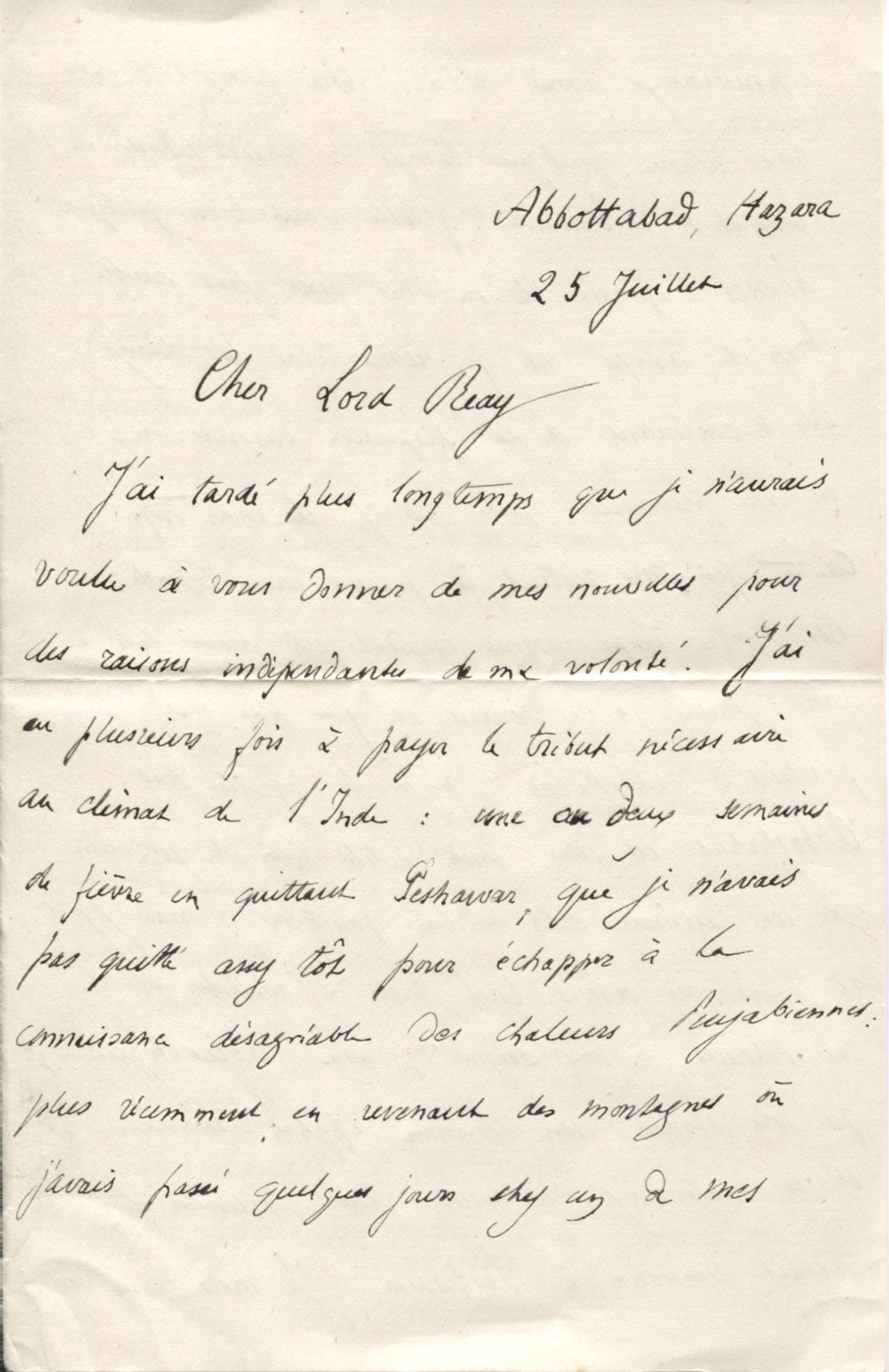
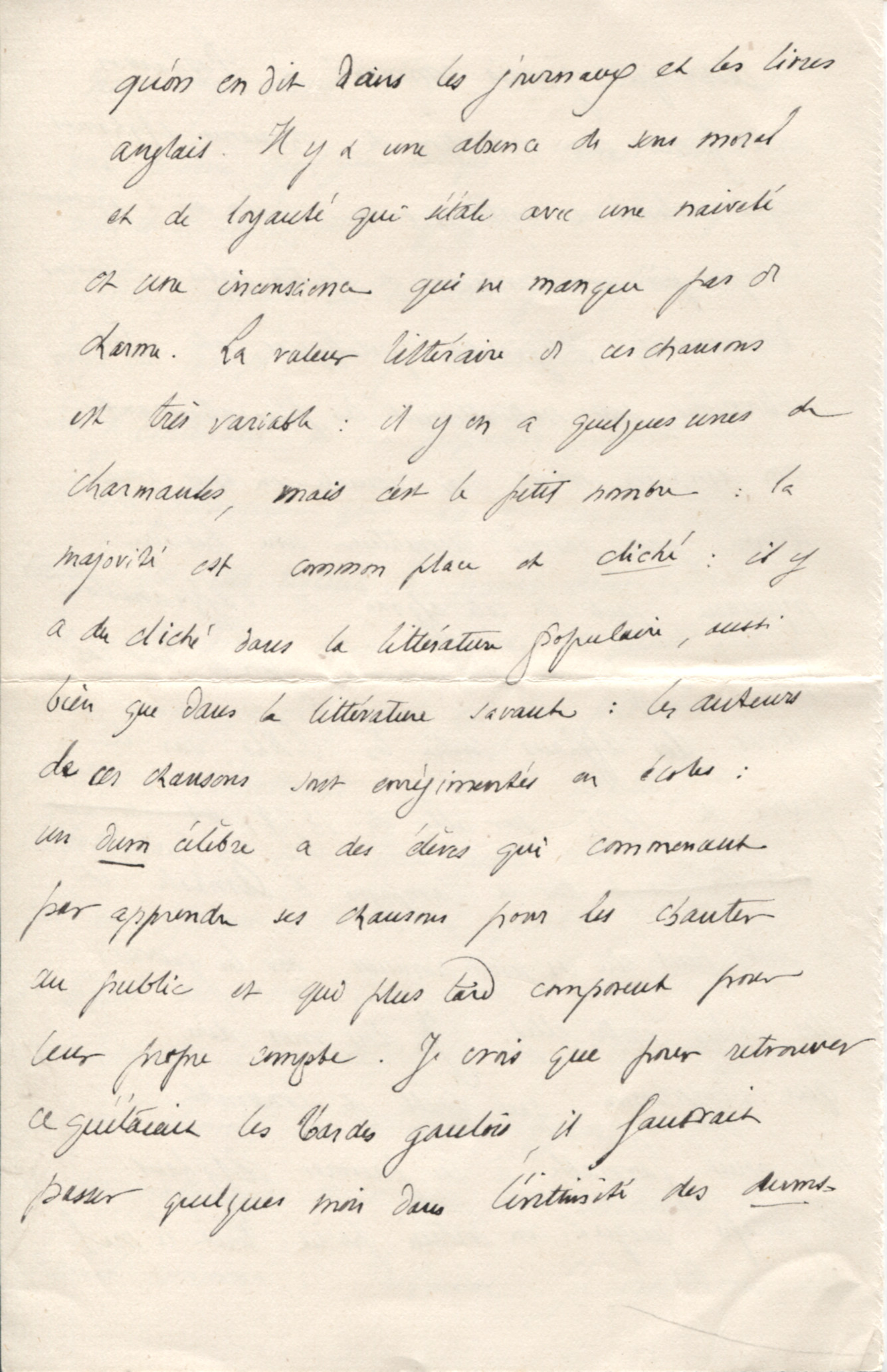
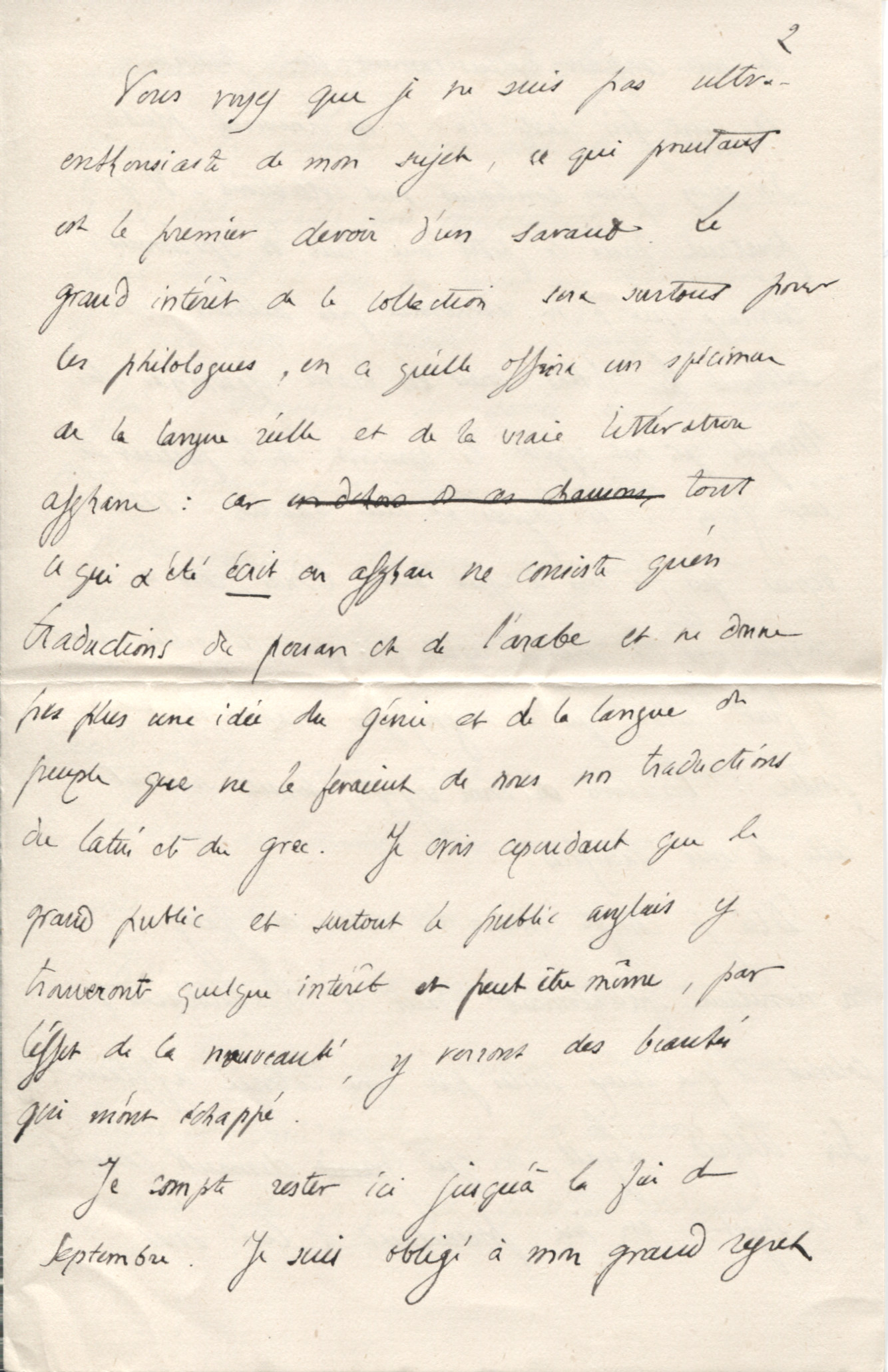
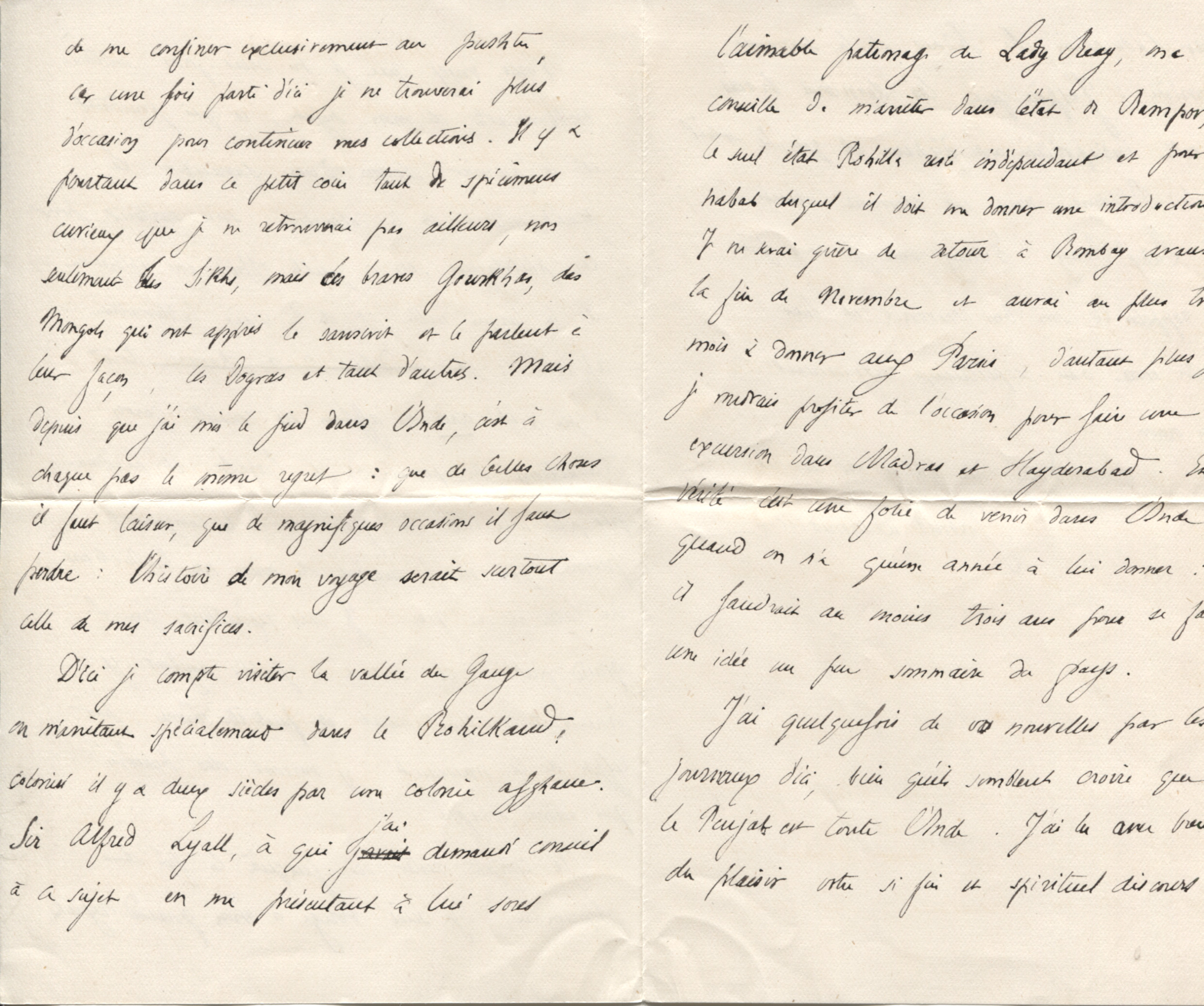
(Donald James Mackay, 1st Baron Reay, 11th Lord, 1839-1921, Dutch born British Administrator and Liberal Politician) saying that he has delayed writing to you longer than I would have liked for reasons beyond my control. I have had to pay the necessary price for the Indian climate several times; a week or two of fever upon leaving Peshawar, which I hadn't left early enough to escape the unpleasant experience of the Punjabi heat; more recently, upon returning from the mountains where I had spent a few days with one of my new friends here, bronchitis kept me here for a while. But India is so beautiful and so interesting that it is well worth a few setbacks, provided they don't cause too much delay, and I will thank the gods if they are content with the current proportion and only take 20% of the all-too-short months I have left to spend in India. These setbacks prevented me from spending the summer in Simla as I had planned, and I settled in Abbottabad instead; I don't regret it. Abbottabad is a very small garrison town, with a Sikh regiment and a Gurkha; but I found friends there all ready to help me and, if necessary, to care for me, a library that astonished me, a devoted Afghan Munshi, and plenty of material to continue the work I began in Peshawar. I believe I told you that I started compiling a collection of Afghan songs in Peshawar. I continued and am still continuing; I have about a hundred of all kinds—love songs, religious songs, political songs, and so on. The latter are naturally the most interesting. My ambition would be to collect enough of them to be able to reconstruct a popular history, told from the Afghan perspective, of Afghanistan since the end of the last century. I have accounts of the Afghan wars against the Sikhs, of the 1835 war, of the 1879 war, of the Ambela campaign, and, perhaps the most curious, of the wars between the tribes. I must tell you that the overall impression is not favourable to these poor Afghans and, to a certain extent, justifies all the bad things said about them in English newspapers and books. There is a lack of moral sense and loyalty displayed with a naiveté and recklessness that is not without a certain charm. The literary value of these songs varies greatly; a few are charming, but they are few and far between; the majority are commonplace and clichés. Clichés exist in popular literature as well as in scholarly literature. The authors of these songs are organised into schools; a famous dum has students who begin by learning his songs to sing them in public and who later compose for themselves. I believe that to truly understand what the Gallic bards were like, one would need to spend a few months in the inner circle of the dums. You can see that I am not particularly enthusiastic about my subject, which is, however, the primary duty of a scholar. The collection will be of great interest to philologists, as it will offer a specimen of the actual Afghan language and true literature. Everything written in Afghan consists only of translations from Persian and Arabic and gives no more insight into the genius and language of the people than our translations from Latin and Greek would. I believe, however, that the general public, and especially the English-speaking public, will find some interest in it and perhaps even, through the novelty of it, will discover beauties that have escaped me. I intend to stay here until the end of September. I am obliged, to my great regret, to confine myself exclusively to Pashtu, because once I leave, I will find no further opportunity to continue my collections. Yet, in this little corner of the world, there are so many curious specimens that I will not find elsewhere; not only Sikhs, but also those brave Gurkhas, Mongols who have learned Sanskrit and speak it in their own way, the Dogras, and so many others. But ever since I set foot in India, every step brings the same regret; so many beautiful things to leave behind, so many magnificent opportunities to miss. The story of my journey will be, above all, the story of my sacrifices. From here, I intend to visit the Ganges Valley, making a special stop in Rohilkhan, which was colonised two centuries ago by an Afghan settlement. Sir Alfred Lyall, whose advice I sought on this matter, presenting myself to him under the kind patronage of Lady Reay, advises me to stop in the state of Rampor. It is the only Rohilkhan state that has remained independent, and he is to arrange an introduction for the Nawab there. I will hardly be back in Bombay before the end of November and will have at most three months to give to the Parsis, especially since I would like to take the opportunity to make a trip to Madras and Hayderabad. Truly, it is madness to come to India when one only has a year to give it. One would need at least three years to get even a basic idea of the country. I sometimes hear news of you from the newspapers here, although they seem to think that Punjab is all of India. I read with great pleasure your witty and insightful speech on the education of the Hindus last week..., 8 sides 8vo., Abbotabad, Hazara, 25th July no year but circa
Item Date: 1886
£975
✓ Available
Background
In 1885 Darmesteter was appointed professor in the Collège de France, and was sent to India in 1886 on a mission to collect the popular songs of the Afghans, a translation of which, with a valuable essay on the Afghan language and literature, he published on his return. His impressions of British rule in India were conveyed in Lettres sur l'Inde (1888).
In 1885 Lord Reay was appointed Governor of Bombay, a post he held until 1890. He was appointed a Knight Grand Commander of the Most Eminent Order of the Indian Empire in 1887 and a Knight Grand Commander of the Most Exalted Order of the Star of India in 1890. After his return to Britain he served as Under-Secretary of State for India between 1894 and 1895 in Lord Rosebery Liberal administration.
Transcription
Abbotabad, Hazara. 25 juillet
Cher Lord Reay. J'ai tardé plus longtemps que je n'aurais voulu à vous donner de mes nouvelles pour des raisons indépendantes de ma volonté. J'ai eu plusieurs fois à payer le tribut nécessaire au climat de l'Inde ; une ou deux semaines de fièvre en quittant Peshawar, que je n'avais pas quitté assez tôt pour échapper à la connaissance désagréable des chaleurs Penjabiennes ; plus récemment en revenant des montagnes où j'avais passé quelques jours chez un de mes nouveaux amis d'ici, une bronchite qui m'a retenu quelque temps ; mais l'Inde est si belle et si intéressante qu'elle vaut bien quelques accrocs, quand ils ne vous font pas perdre trop de temps et je remercierai les dieux s'ls se contentent de la proportion présente et ne me prennent que 20% des mois trop courts qui me restent à passer dans l'Inde. Ces contre temps m'ont empêché de passer l'été à Simla comme je le pensais et j'ai pris mes quartiers à Abbotabad ; je ne le regrette pas. Abbotabad est une toute petite ville de garnison, avec un régiment sikh et un gourkha ; mais j'y ai trouvé des amis tout prêts à m'aider et le cas échéant à me soigner, une bibliothèque qui m'a étonné, un Munshi afghan dévoué et des matériaux en nombre pour continuer le travail commencé à Peshawar. Je crois vous avoir dit que j'avais commencé à Peshawar à former une collection de chansons afghanes. J'ai continué et continue encore ; j'en ai à peu près une centaine de toutes sortes, chansons d'amoureuses, religieuses, politiques, etc. Les dernières sont naturellement les plus intéressantes. Mon ambition serait d'en recueillir en assez grand nombre pour pouvoir reconstituer une histoire populaire, faite du côté afghan, de l'Afghanistan depuis la fin du siècle dernier. J'en ai sur les guerres des Afghans peut-être les plus curieuses, sur les guerres des tribus entre elles. Je dois vous dire que l'impression qui résulte de l'ensemble n'est point favorable à ces pauvres Afghans et justifie jusqu'à un certain point tout le mal qu'on en dit dans les journaux et les livres anglais. Il y a une absence de sens moral et de loyauté qui s'étale avec une naïveté et une inconscience qui ne manque pas de charme. La valeur littéraire de ces chansons est très variable ; il y en a quelques-unes de charmantes, mais c'est le petit nombre ; la majorité est common place et cliché ; il y a du cliché dans la littérature populaire, aussi bien que dans la littérature savante ; les auteurs de ces chansons sont enrégimentés en écoles ; un dum célèbre a des élèves qui commencent par apprendre ses chansons pour les chanter au public et qui plus tard composent pour leur propre compte. Je crois que pour retrouver ce qu'étaient les bardes gaulois, il faudrait passer quelques mois dans l'intimité des dums. Vous voyez que je ne suis pas ultra enthousiaste de mon sujet, ce qui pourtant est le premier devoir d'un savant. Le grand intérêt de la collection sera surtout pour les philologues, en ce qu'elle offrira un spécimen de la langue réelle et de la vraie littérature afghane ; tout ce qui a été écrit en afghan ne consiste qu'en traduction de persan et de l'arabe et ne donne pas plus une idée du génie et de la langue du peuple que ne le ferait de nous nos traductions de latin et du grec. Je crois cependant que le grand public et surtout le public anglais y trouveront quelque intérêt et peut-être même, par l'effet de la nouveauté, y verront des beautés qui m'ont échappé. Je compte rester ici jusqu'à la fin de septembre. Je suis obligé à mon grand regret de me confiner exclusivement au pashtu car une fois parti d'ici je ne trouverai plus d'occasion pour continuer mes collections. Il y a pourtant dans ce petit coin tant de spécimens curieux que je ne retrouverai pas ailleurs, non seulement des Sikhs, mais ces braves Gourkhas, des Mongols qui ont appris le sanscrit et le parlent à leur façon, les Dogras et tant d'autres. Mais depuis que j'ai mis le pied dans l'Inde, c'est à chaque pas le même regret ; que de belles choses il faut laisser, que de magnifiques occasions il faut perdre ; l'histoire de mon voyage serait surtout celle de mes sacrifices. D'ici, je compte visiter la vallée du Gange en m'arrêtant spécialement dans le Rohilkand, colonisé il y a deux siècles par une colonie afghane. Sir Alfred Lyall, à qui j'ai demandé conseil à ce sujet en me présentant à lui sous l'aimable patronage de Lady Reay, me conseille de m'arrêter dans l'état de Rampor. Le seul état Rohill resté indépendant et pour le nabab duquel il doit me donner une introduction. Je ne serai guère de retour à Bombay avant la fin de novembre et aurai au plus trois mois à donner aux Parsis, d'autant plus que je voudrais profiter de l'occasion pour faire une excursion dans Madras et Hayderabad. En vérité c'est une folie de venir dans l'Inde quand on n'a qu'une année à lui donner. Il faudrait au moins trois ans pour se faire une idée un peu sommaire du pays. J'ai quelquefois de vos nouvelles par les journaux d'ici, bien qu'ils semblent croire que le Penjab est toute l'Inde. J'ai lu avec beaucoup de plaisir votre si fin et spirituel discours sur l'éducation des Indous de la semaine dernière. J'espère que les dernières traces de votre indisposition ont disparu et que le soleil de la Présidence vous est clément ainsi qu'à Lady Reay. Voulez-vous je vous prie me rappeler à son bon souvenir et lui présenter mes bien respectueux dévouements et me croire Votre bien obligé et dévoué. James Darmesteter
Translation
Abbotabad, Hazara. July 25
Dear Lord Reay, I have delayed writing to you longer than I would have liked for reasons beyond my control. I have had to pay the necessary price for the Indian climate several times; a week or two of fever upon leaving Peshawar, which I hadn't left early enough to escape the unpleasant experience of the Punjabi heat; more recently, upon returning from the mountains where I had spent a few days with one of my new friends here, bronchitis kept me here for a while. But India is so beautiful and so interesting that it is well worth a few setbacks, provided they don't cause too much delay, and I will thank the gods if they are content with the current proportion and only take 20% of the all-too-short months I have left to spend in India. These setbacks prevented me from spending the summer in Simla as I had planned, and I settled in Abbottabad instead; I don't regret it. Abbottabad is a very small garrison town, with a Sikh regiment and a Gurkha; but I found friends there all ready to help me and, if necessary, to care for me, a library that astonished me, a devoted Afghan Munshi, and plenty of material to continue the work I began in Peshawar. I believe I told you that I started compiling a collection of Afghan songs in Peshawar. I continued and am still continuing; I have about a hundred of all kinds—love songs, religious songs, political songs, and so on. The latter are naturally the most interesting. My ambition would be to collect enough of them to be able to reconstruct a popular history, told from the Afghan perspective, of Afghanistan since the end of the last century. I have accounts of the Afghan wars against the Sikhs, of the 1835 war, of the 1879 war, of the Ambela campaign, and, perhaps the most curious, of the wars between the tribes. I must tell you that the overall impression is not favorable to these poor Afghans and, to a certain extent, justifies all the bad things said about them in English newspapers and books. There is a lack of moral sense and loyalty displayed with a naiveté and recklessness that is not without a certain charm. The literary value of these songs varies greatly; a few are charming, but they are few and far between; the majority are commonplace and clichés. Clichés exist in popular literature as well as in scholarly literature. The authors of these songs are organised into schools; a famous dum has students who begin by learning his songs to sing them in public and who later compose for themselves. I believe that to truly understand what the Gallic bards were like, one would need to spend a few months in the inner circle of the dums. You can see that I am not particularly enthusiastic about my subject, which is, however, the primary duty of a scholar. The collection will be of great interest to philologists, as it will offer a specimen of the actual Afghan language and true literature. Everything written in Afghan consists only of translations from Persian and Arabic and gives no more insight into the genius and language of the people than our translations from Latin and Greek would. I believe, however, that the general public, and especially the English-speaking public, will find some interest in it and perhaps even, through the novelty of it, will discover beauties that have escaped me. I intend to stay here until the end of September. I am obliged, to my great regret, to confine myself exclusively to Pashtu, because once I leave, I will find no further opportunity to continue my collections. Yet, in this little corner of the world, there are so many curious specimens that I will not find elsewhere; not only Sikhs, but also those brave Gurkhas, Mongols who have learned Sanskrit and speak it in their own way, the Dogras, and so many others. But ever since I set foot in India, every step brings the same regret; so many beautiful things to leave behind, so many magnificent opportunities to miss. The story of my journey will be, above all, the story of my sacrifices. From here, I intend to visit the Ganges Valley, making a special stop in Rohilkhan, which was colonised two centuries ago by an Afghan settlement. Sir Alfred Lyall, whose advice I sought on this matter, presenting myself to him under the kind patronage of Lady Reay, advises me to stop in the state of Rampor. It is the only Rohilkhan state that has remained independent, and he is to arrange an introduction for the Nawab there. I will hardly be back in Bombay before the end of November and will have at most three months to give to the Parsis, especially since I would like to take the opportunity to make a trip to Madras and Hayderabad. Truly, it is madness to come to India when one only has a year to give it. One would need at least three years to get even a basic idea of the country. I sometimes hear news of you from the newspapers here, although they seem to think that Punjab is all of India. I read with great pleasure your witty and insightful speech on the education of the Hindus last week. I hope the last traces of your indisposition have disappeared and that the sun of the Presidency is kind to you and Lady Reay. Please bear in mind that I am with her and offer my most respectful regards. Yours sincerely, James Darmesteter
Stock No. 43599
Guaranteed Authentic
Worldwide Shipping
ABA / ILAB Member
Returns Policy