Military or Naval
WELLINGTON RECOMMENDS A COLLEAGUE FOR A SEAT IN TIPPERARY
WELLINGTON
(Arthur Wellesley, Duke of, 1769-1852, Field Marshal & Statesman)
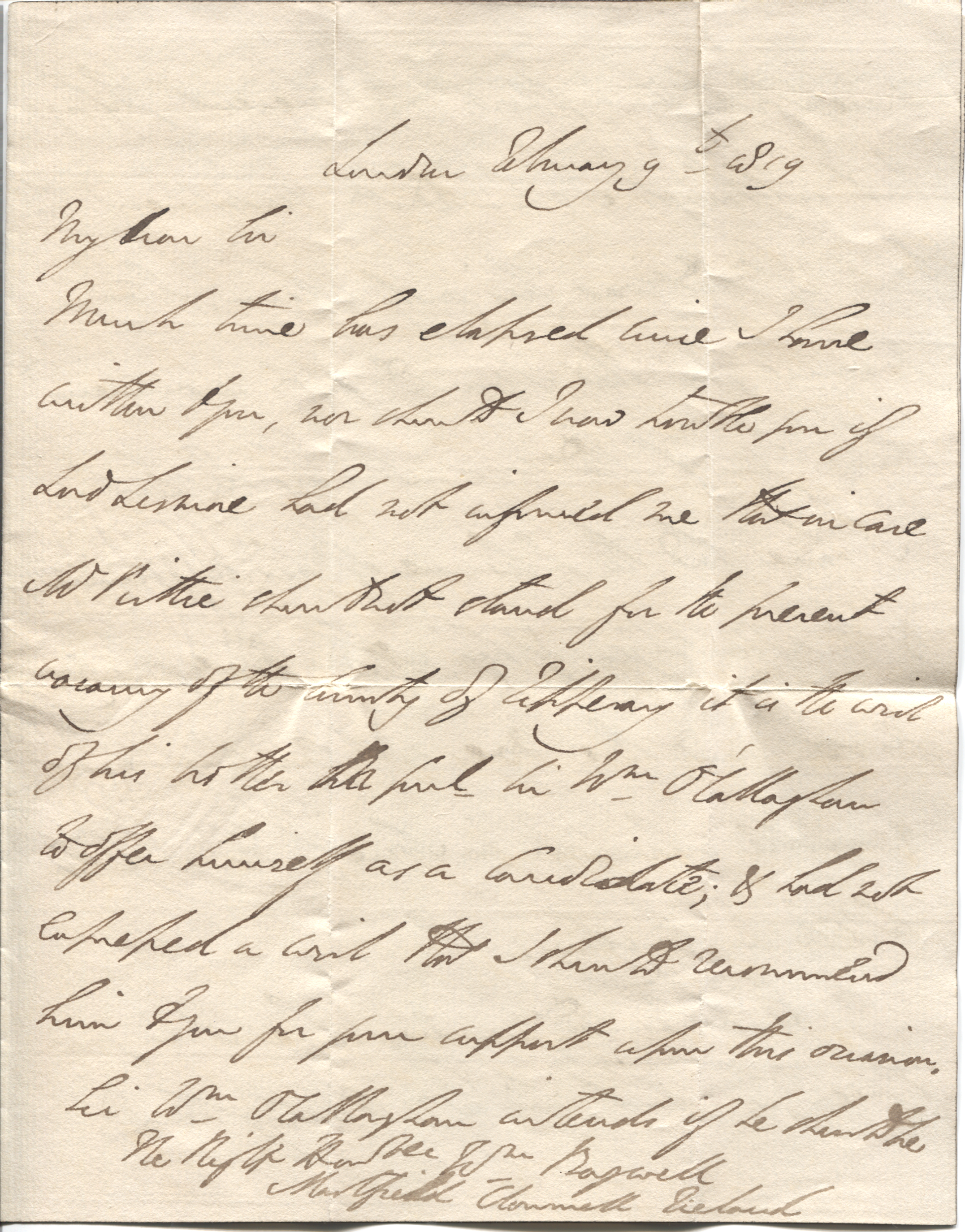
Important Autograph Letter to My dear Sir, 'The Right Honble Wm BAGWELL'
(of Marlfield, Clonmel, Ireland, 1776-1826, Irish Politician) saying that much time has elapsed since I have written to you, nor should I now trouble you if Lord Lismore had not informed me that in case Mr Pettrie should not stand for the present vacancy of the County of Tipperary it is the wish of his brother the Genl Sir Wm O'Callagham to offer himself as a Candidate; & he had expressed a wish that I should remember him to you for your support... Sir Wm O'Callaghan intends if he should be successful to support the present Govt but although I should not recommend him to you if that was his only claim, I can promise you that I would not recommend him to you if that was not his intention. I have had the pleasure of his acquaintance & the advantage of his Assistance for many years and there does not exist a more amiable character in Society not a better Soldier in the Army. He hopes that you may have it in your power to assist..., 3 sides 4to., London, 9th February
Item Date: 1819
£425
✓ Available
Background
After the end of his active military career, Wellington returned to politics. He was twice British prime minister as part of the Tory party: from 1828 to 1830, and for a little less than a month in 1834. He oversaw the passage of the Catholic Relief Act 1829, but opposed the Reform Act 1832. He continued as one of the leading figures in the House of Lords until his retirement and remained Commander-in-Chief of the British Army until his death.
Lieutenant General Sir Robert William O'CALLAGHAN (1777-1840) was the 2nd son of the 1st Baron Lismore. He served in the Peninsular War and temporarily commanded a brigade within the 2nd Division between January and July 1813 and permanently commanded a brigade of the 2nd Division between February and April 1814. He went on to command the 13th Brigade in France in 1815, the 3rd Brigade between 1815 and 1817 and the 7th Brigade in 1818. He served with the Army of Occupation in France and then became Commander-in-Chief, Scotland in 1825 and Commander-in-Chief of the Madras Army in 1831 before retiring in 1836. He sat in the Irish House of Commons as the Member of Parliament for Bandonbridge from 1798 to 1800.
Bagwell was elected at a by-election in 1801 as MP for constituency of Clonmel in the Parliament of the United Kingdom and held that seat until his resignation in 1819 to fight a by-election for the Tipperary seat when the prior member succeeded to the Irish Peerage as Earl of Glengall. He won the seat and held it until the 1826 general election.
Stock No. 43840
Guaranteed Authentic
Worldwide Shipping
ABA / ILAB Member
Returns Policy