Political
MORTON
(James Douglas, c.1516-1581, Lord Chancellor of Scotland, 1563-1566 and 1567-1573, Regent for James VI 1572-1578, from 1553 4th Earl)
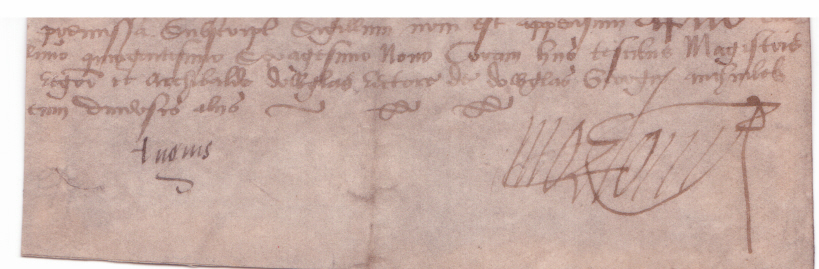
Signature from the end of a document in Latin
with transcription and translation, In witness whereof I [have put] my hand to these presents... to which also my seal is appended. In the presence of these witnesses... Archibald Douglas rector of Douglas, George Auchinlek... with divers others, vellum, 1 side 2x5¼, Dalkeith,
Item Date: 1569
lacking the beginnings of the lines present
£375
✓ Available
Background
Morton procured the murder of Rizzio, 'discovered' the casket letters and led the van at the battle of Langside against Mary's supporters. He was also implicated in Darnley's murder, for which he was finally charged and executed in 1581.
The Archibald Douglas who witnessed this document was a cousin of Morton's wife, being a grandson of the 2nd Earl. (Morton was Earl in right of his wife). The old kirk at Douglas where he was rector is the burial place of the Douglases. He too was implicated in Rizzio's and Darnley's murder. By 1572 he had been installed, after great opposition, as parson of Glasgow (St. Mungo's, the cathedral). When Morton was apprehended in 1580, Douglas was forewarned and fled to England. A packed jury acquitted him of all treasons in 1586, and he was sent as ambassador to England, where he contributed to the condemnation of Queen Mary.
Signed also 'Angius', i.e. 'of Angus', the 8th Earl, 1553-1588, another Archibald Douglas, Morton's nephew and ward, being the son of Morton's elder brother David, briefly 3rd Earl in 1555. The young earl attended St. Andrews, and carried the sword at James' first parliament in 1567. When his uncle was apprehended in December 1580 by his political enemies, he planned an English invasion to support him, but was detected and fled to England., where he got to know Sir Philip Sidney. He was later pardoned, and was lieutenant-general of Scotland in 1586. His neat signature is based on Italian models rather than a secretary hand.
Stock No. 50750
Guaranteed Authentic
Worldwide Shipping
ABA / ILAB Member
Returns Policy